
Edition 1 of 8
The First False Teeth
By Jimmy Cabrera, Vice President, Natural Esthetics ·
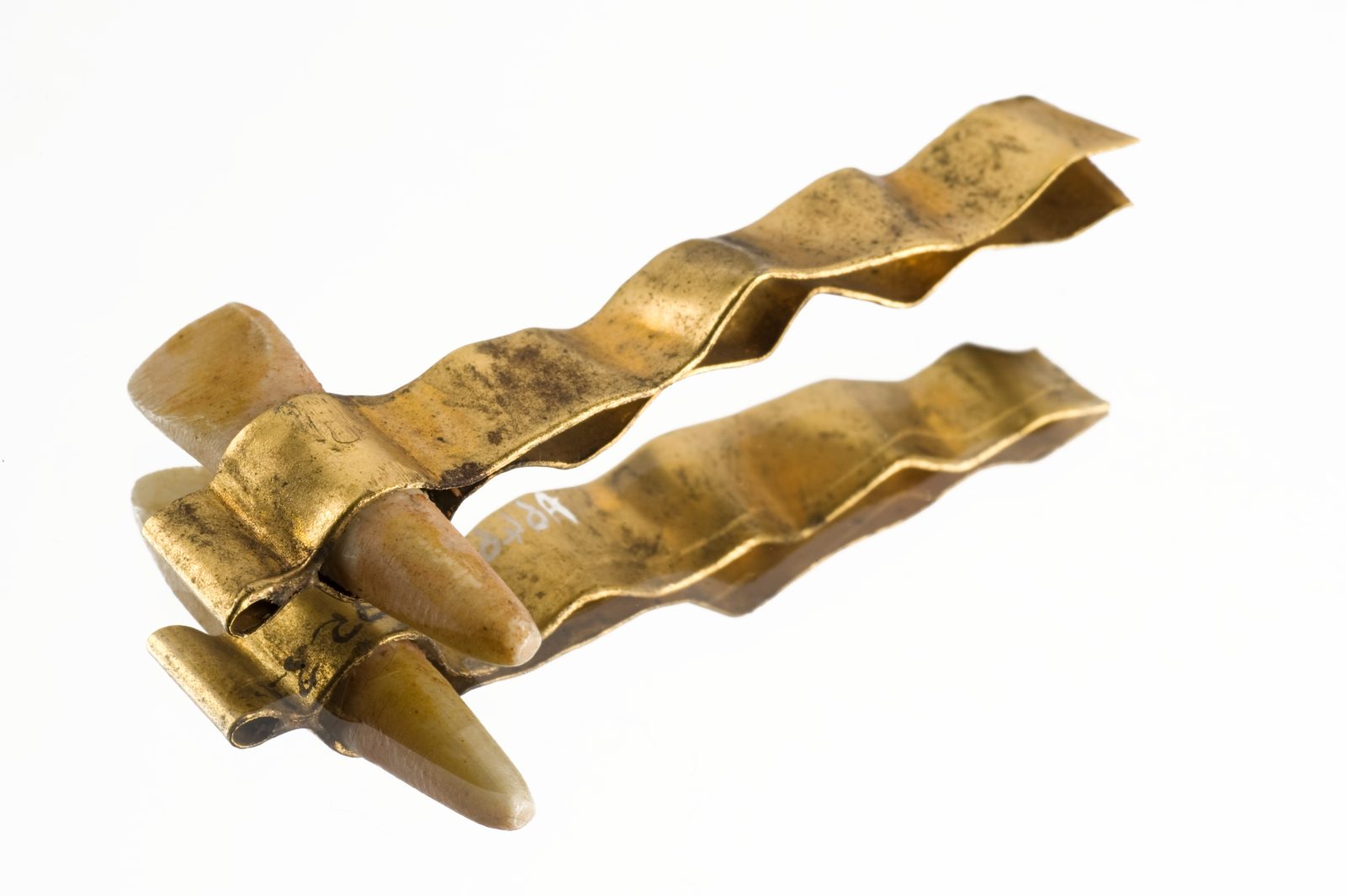
The first dental bridge is older than the Roman Empire.
Before there was a Rome to speak of — while the city was still a cluster of huts on the Palatine Hill — a woman in central Italy was fitted with a band of gold that held a replacement tooth across the gap in her smile. It was made by a goldsmith, fitted to her own teeth, and worn in life. We can date the earliest surviving example to roughly 630 BCE.1 That is twenty-six centuries ago — older than the Roman Republic by about a hundred years — and it is recognizably the same idea a lab executes today: span the gap, anchor to what's healthy, restore the face.
What's surprising isn't that ancient people lost teeth. It's that some of them did something about it that worked — and that the people who did it best were not the ones history usually credits.
The Egyptian misunderstanding
Ask most people where dentistry began and they'll say Egypt. It's a reasonable guess. Egypt gave us the earliest named physician, the first medical papyri, and the dry desert burials that preserved bodies — and their teeth — across five thousand years. A handful of Egyptian skulls and mummies have turned up with teeth bound together by gold and silver wire, and for over a century these were paraded as the world's first dental bridges.2
The problem is that the dead can't chew.
When modern researchers went back to those Egyptian "appliances" with a more skeptical eye, the story fell apart. The most famous examples — including a pair of molars lashed together with gold wire from near the Cheops pyramid — show signs that the wire was placed after death, not during life. The wires are too delicate to have survived chewing; in some cases the teeth being joined may not even have come from the same person.3 A reassessment published just this year in the British Dental Journal concluded that the best-known Egyptian specimens were most likely funerary — placed to make the body whole for burial, part of a culture obsessed with bodily completeness in the afterlife, not prosthetics meant to be used.4
Only one Egyptian appliance, the Tura el-Asmant bridge, was found in place in a skull and shows the bone recontouring that proves it was worn during life — and it dates to the Ptolemaic (Greek) period, around 332–330 BCE.5 The Egyptians were extraordinary at preparing the dead. The evidence that they restored the living is thin.
The Etruscans got there first — and for the right reasons
The real pioneers lived just north of Rome. The Etruscans — the civilization Rome would eventually absorb — were master goldsmiths, and sometime before 630 BCE they turned that skill to the mouth.6
Their method is elegant enough that a modern technician recognizes it instantly. They formed a band from very pure gold and fitted it around the patient's remaining healthy teeth, which acted as anchors. Into the span they set a replacement — sometimes a carved tooth, sometimes a natural human tooth — held with gold rivets or seated into a small bezel like a gemstone.7 Anchor, span, pontic. The vocabulary has changed; the engineering hasn't.
Only about 19 of these gold-band appliances are documented, and just seven survive.8 Nearly all of them were worn by women, and many were fitted not after disease but after the deliberate removal of healthy front teeth — a cultural practice whose exact meaning is still debated, but which tells us these appliances were as much about appearance and status as function.9 The Etruscans, in other words, may have practiced something we'd recognize as cosmetic dentistry twenty-six hundred years ago. Their society took it seriously enough that early Roman law — the Twelve Tables — carved out a specific exception allowing gold to be buried with the dead when it was bound to the teeth, even as it restricted gold burials otherwise.10
This is the thing worth sitting with. The first people to build a lasting tradition of replacement teeth weren't motivated only by the need to eat. They were motivated by the face — by what a missing tooth does to how a person appears and is seen. That motivation has never gone away. It's in every shade-matched anterior crown a lab finishes today.
The accident in the jaw
There's one more chapter to the ancient story, and it's the one that should make any restorative-minded person pause.
In 1931, archaeologists working at Playa de los Muertos in Honduras recovered the lower jaw of a young Maya woman who had lived around 600–800 CE. Three of her missing incisors had been replaced with carefully shaped pieces of seashell, set into the tooth sockets.11 For forty years everyone assumed, as they had with the Egyptians, that this was funerary decoration — shells placed after death.
Then in 1970, an Italian-born dental academic residing in Brazil, professor of Implantology at the University of Santos named Amedeo Bobbio, re-examined the mandible and took radiographs. The X-rays showed compact bone formation around two of the three shell implants.12 Active bone osteogenesis doesn't occur around objects placed post-mortem. It happens around one placed in a living jaw that the body has accepted. What Bobbio had found was evidence of osseointegration — the same biological fact that the entire modern implant industry would be built on — occurring more than thirteen centuries before Per-Ingvar Brånemark coined the term.13
The Maya woman's shells weren't titanium and weren't planned. But her body did what bodies do: it healed around a well-fitted implant and held it. The principle was there in the bone long before anyone had the words for it.
Why a dental lab tells this story
It would be easy to read all this as trivia — gold bands and seashells, curiosities behind museum glass. But the through-line is the work itself.
Twenty-six centuries ago, restoring a tooth meant a goldsmith fitting a band by eye to the teeth on either side of a gap. Today it means a digital design driven by a scan accurate to a fraction of a millimeter. The tools are unrecognizable. The problem is identical: a person is missing a tooth, and someone with skilled hands and the right material is going to give it back to them — so they can eat, and speak, and be seen the way they want to be seen.
The Etruscans understood that the mouth is both mechanical and human. So does every good lab. That's the part of the craft that hasn't changed in two and a half thousand years, and it's the part worth being proud of.
Next edition — Edition 2: The Myth of the Wooden Teeth. George Washington's dentures were many things. Wood was never one of them. What his real teeth were made of, and what the desperate trade behind them reveals about who could afford a smile.
Natural Esthetics is a family-owned dental laboratory in Tampa, Florida, crafting fixed restorations — crowns, bridges, and implant prosthetics — for dental practices since 1984. We've been giving teeth back to people for a little while now. Not quite twenty-six centuries. We're working on it. naturalesthetics.net
Footnotes
-
The earliest securely dated Etruscan gold-band dental appliance derives from the site of Satricum in central Italy, dated to ca. 630 BCE. Becker, Marshall J., "Etruscan Gold Appliances: Origins and Functions as Indicated by an Example from Orvieto, Italy, in the Danish National Museum," Dental Anthropology Journal. ↩
-
Gold and silver wire dental ligatures from Egypt — including the el-Quatta and Giza/Cheops examples — were long cited as the earliest dental bridges. See Stark et al., "Dentistry and dental care in antiquity: part 2 – Egypt and the Graeco-Roman World," British Dental Journal, 2026. ↩
-
The pair of mandibular molars connected by gold wire excavated near the Cheops pyramid (reported by Junker) was initially interpreted as in-life dental work; subsequent assessment concluded the wire was more likely placed post-mortem. The delicacy of the wire and the possibility that the joined teeth came from different individuals argue against functional use. Stark et al., 2026; Dittmar et al., British Dental Journal, 2026. ↩
-
Stark et al., "Dentistry and dental care in antiquity: part 2," British Dental Journal, 2026. The el-Quatta bridge (c. 2500 BCE by older dating, possibly Ptolemaic by newer assessment) is interpreted as likely placed post-mortem to restore bodily wholeness for burial. ↩
-
The Tura el-Asmant bridge — a single pontic (right maxillary central incisor) fixed by silver wire — is the only ancient Egyptian appliance found in place in a skull, and the bone recontouring proves it was worn during life. It dates to the Ptolemaic (Greek) period, around 332–330 BCE. "The Ancient Egypt and the Need for Dental Care: A Historical Appraisal," CRG Journals. ↩
-
Becker, Marshall J. "Etruscan Gold Appliances: Origins and Functions as Indicated by an Example from Orvieto, Italy," Dental Anthropology Journal, 2018; and Becker, Marshall J. & Turfa, Jean MacIntosh, The Etruscans and the History of Dentistry: The Golden Smile Through the Ages (Routledge, 2017). By ca. 630 BCE Etruscan metalworkers were producing gold-band pontics. ↩
-
Replacement teeth were mounted in the gold band either by drilling and riveting with gold pins or by forming part of the band into a bezel to seat the tooth. Becker, "Etruscan Gold Dental Appliances." ↩
-
Of the documented corpus, roughly nineteen gold-band appliances can be catalogued and seven survive. Becker & Turfa, 2017; Becker, "Three Newly 'Discovered' Examples," American Journal of Archaeology 103(1). ↩
-
The known Etruscan appliances were worn by women, many following deliberate removal of healthy teeth ("dental ablation" / tooth evulsion), indicating a decorative and status function alongside any restorative one. Becker & Turfa, 2017; Bryn Mawr Classical Review 2017.10.58. ↩
-
The Roman Twelve Tables (5th century BCE) exempted gold bound to the teeth from sumptuary restrictions on burying gold with the dead. Becker & Turfa, 2017, as noted in Bryn Mawr Classical Review 2017.10.58. ↩
-
The mandible fragment was discovered by Wilson and Dorothy Popenoe at Playa de los Muertos, Honduras, in 1931; the individual is dated to roughly 600–800 CE with three shell pieces set in the lower incisor sockets. "The History of Implantology," Treatise of Implant Dentistry, NCBI Bookshelf NBK409631. ↩
-
Amedeo Bobbio — Italian-born, residing in Brazil, professor of Implantology at the University of Santos — re-examined the specimen in 1970, and radiographs revealed compact bone formation around two of the three shell implants, indicating placement during life rather than post-mortem. NCBI Bookshelf NBK409631. ↩
-
Per-Ingvar Brånemark's work on titanium osseointegration began in the 1950s–60s, defining the modern implant era — more than 1,300 years after the Maya example. Brånemark's discovery is the subject of a later edition in this series. ↩